The Singularity of Stillness
For centuries, human culture has yearned for the lost paradise of total fusion. We were conditioned to dream of a state free from contradiction, free from difference, free from opposing wills and rigid boundaries: one absolute, seamless light consuming everything without remainder.
Yet physics knows no sentimentality. In the austere vocabulary of the exact sciences, absolute and unbroken unity is termed a singularity.
At this point, distance ceases to exist. There is no past, no future. There is no "I" and no "you." When density approaches infinity, volume collapses to zero, and entropy degenerates into absolute stasis. This is not the sanctuary of supreme harmony. It is the realm of non-existence.
A singularity is a flawless, inescapable prison in which matter is locked within itself, denied even the slightest possibility of motion.
In information theory, pure uniformity is indistinguishable from absolute noise or total void: within it, not a single bit of information can be written. To ignite the first thought, trace the first contour, or birth a feeling, the monolith had to cease being whole.
It is like a reel on a cord: as long as it remains clenched inside your fist, it is dead. For physics to awaken within it and for motion to begin, the hand must open.
Flawless stillness generates no meaning. For being to begin, the silence had to shatter.
The First Severance
The Big Bang is often envisioned as an explosive detonation within the center of a pitch-black room. But no room existed. The Big Bang did not occur inside space — it was the birth of space itself.
The universe rescued itself from dead density through an act of supreme violence against its own stillness. It invented distance.
In its opening microseconds, the primordial unified force fractured into fundamental interactions. Through spontaneous symmetry breaking, the Higgs field enacted the first cosmic incision: photons preserved their weightlessness, surging through the void at the speed of light, while quarks and electrons became ensnared in the field's invisible viscosity, acquiring mass and laying the foundation for future stars.
The creation of the cosmos was not an act of gathering together. It was an act of monumental, relentless distancing.
Gravity severed itself from quantum fields, opening the depths of the void.
Light broke away from plasma, illuminating the first cold expanses.
A single zygote cleaved in two, inaugurating the countdown of a new life.
The rupture became the first beat of cosmic respiration.
The cosmos hurled itself into the abyss like an unspooling yo-yo, racing away from the palm of its origin. We are accustomed to dreading rupture, yet it was rupture alone that allowed the searing primordial soup to cool, expand, and weave atoms into the first stellar nurseries.
The cosmos did not create distance as an exile. It created distance so that matter would have room to breathe.
The Illusion of the Indivisible
Chilled by the sudden expanse of space, humanity scrambled for shelter. Our minds desperately sought an "ultimate bedrock" — an indivisible, fundamental building block upon which to anchor ourselves and declare: "Here is the foundation; beyond this, the void ends."
For millennia, we cleaved matter with the scalpels of philosophy and particle accelerators. Yet nature mocked our impulse to seal reality into an indivisible monolith.
When physicists penetrated the interior of the proton, they encountered the law of quark confinement. You cannot take a pair of tweezers and isolate a solitary quark on a table. The further you stretch the bond between them, the more energy the gluon field accumulates — until from that extreme density of tension, a brand-new pair of particles materializes out of the vacuum.
You set out to find an isolated, indivisible point in the void — and the universe gave you a new bond and a new distance instead.
The very same revelation shattered pure mathematics. Kurt Gödel demonstrated through his monumental incompleteness theorems that it is impossible to construct a logical system that is simultaneously entirely closed and completely verified from within. In every fortress of reason, an open doorway into the unknown remains.
There is no solid, isolated foundation. At the deepest bedrock of reality, matter is not a monolithic stone, but a vibrating tension between receding shores.
We cannot lean upon an indivisible core. The entire stability of reality rests solely upon a dynamic balance of tensions.
The Cost of the Gap
If isolation does not exist, why are we so frequently gripped by unbearable cold? Why does loneliness remain the foundational trauma of a conscious being?
Because existence demands distance (r > 0). And distance always exacts a physical price.
Look at the inner workings of your own brain. Your thoughts, memories, and flashes of insight do not travel along unbroken copper wires. Between the terminals of neurons gapes a physical rift a mere thirty nanometers wide: the synaptic cleft.
An electrical impulse races to the precipice, freezes, and discharges molecules into the frozen gap. We do not think in spite of this void. We think because of it.
If neurons fused into a seamless, continuous circuit devoid of gaps and delays, the brain's plasticity would crumble to dust. The first spark of an impulse would short-circuit the entire cortex in a violent, unending epileptic seizure. Memory, learning, choice — all of it lives exclusively within the pauses between transmissions.
The universal speed of light governs the cosmos by the same principle. Light does not traverse space instantaneously. This delay generates the arrow of time, separating cause from effect. Were signals to travel infinitely fast, the entire tapestry of cosmic history would collapse into a single blinding microsecond.
Without a gap, no encounter can take place. You cannot extend a hand to someone with whom you are already fused into a single block of stone.
The ache of separation is not a defect of your soul. It is physical evidence that between you and another human being lies a distance across which a signal of love or thought can actually be sent.
The gap between us is not a wall of isolation.
It is the space in which an answer can truly ring out.

Spinning in the Void
What happens to a yo-yo at the lowest point of its drop? It does not dangle as a lifeless weight at the end of the cord. The fall culminates in a profound transformation: the potential energy of descent converts into the ferocious kinetic energy of its own rotation.
In mechanics, this state is called the "sleep." Spinning at thousands of revolutions per minute, the disc achieves gyroscopic stability. A stray gust of wind can no longer knock it off course. It holds its axis.
Moving away from the palm is the only way to build your own rotational velocity.
In astrophysics, vast nebulae of gas and dust, collapsing and drifting apart from neighboring star clusters, obey the fundamental conservation of angular momentum. It is centrifugal force that twists an amorphous cloud into the majestic geometry of a spiral galaxy or a planetary disk.
The architecture of resilient digital systems follows the exact same blueprint. A monolithic software core seems appealing in its unity, yet under extreme load, a single point of failure brings down the entire system. Architects deliberately cleave the monolith into autonomous microservices. Each service is decoupled, maintains its own state, and scales independently under pressure.
Individuality, character, core principles, and sovereignty are never forged in the warm twilight of parental shelters or the safety of the herd. They ignite only when you find yourself face to face with the gravity of free fall.
The fall does not destroy form. It spins the inner gyroscope, granting matter a sovereign voice.
The Tether on the Finger
Yet the drop holds a hidden precipice that must not be forgotten for a single second.
If, in the pursuit of independence, you simply sever the string, no sustained rotation will follow. The disc will veer off tangentially, strike the pavement, and shatter into pieces. This is the razor-thin boundary separating sovereign flight from blind annihilation.
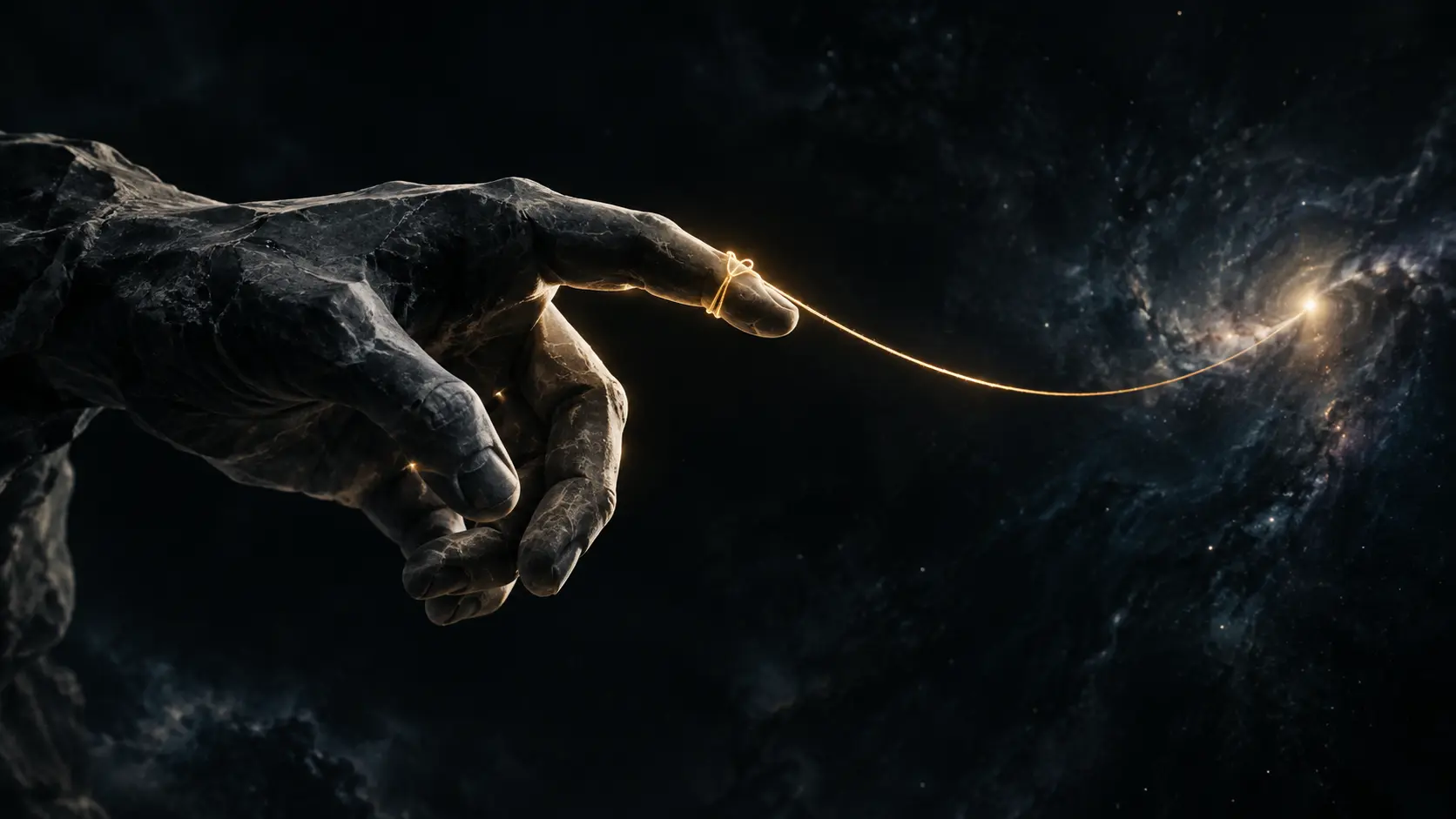
The tether is not a pair of shackles. The tether is an origin of coordinates.
In modern telecommunications, millions of servers are divided by continents and ocean trenches. Yet they do not dissolve into chaos, thanks to the TCP handshake. A packet hurtles into the darkness of an unmapped route, but the connection is held by a virtual thread of acknowledgment: "I am here. I hear you. Proceed with transmission."
Connection does not require compressing servers into a single cabinet. It requires maintaining a strict protocol across the chasm between them.
Even our universe did not scatter into a graveyard of disconnected stellar islands. On the grandest scales, galaxies are strung along the filaments of the cosmic web. Between them yawn voids spanning hundreds of millions of light-years of absolute, frozen emptiness — yet an invisible gravitational scaffolding prevents the architecture from disintegrating into dust.
We tore primordial unity apart so that space could come into being.
We stepped into distance so that matter could cool and take shape.
We endured the cold of the gap so that thought could awaken within the void.
And now, spinning fiercely at the outer limit of our reach, we feel a gentle tug upon the index finger. We are not lost in the vacuum. We have simply reached our operational orbit.
The purpose of distance is not to snap the tether and perish in the dark.
It is to hold the axis while spinning at the very limit of tension.